
When I first wondered “how does compound interest work?” I honestly pictured a wall of equations and instantly wanted a nap. Then I ran a few real-life numbers on my own savings and debt—and suddenly I was wide awake. Compound interest is one of those money concepts that quietly decides whether future you is calm and comfortable… or constantly playing catch-up.
Let’s break it down in a super simple, practical way so you can use it on purpose instead of letting it work against you.
What Is Compound Interest in Plain English?
Compound interest is interest you earn on your original amount (principal) plus all the interest that’s already been added before. In other words, it’s “interest on interest.”
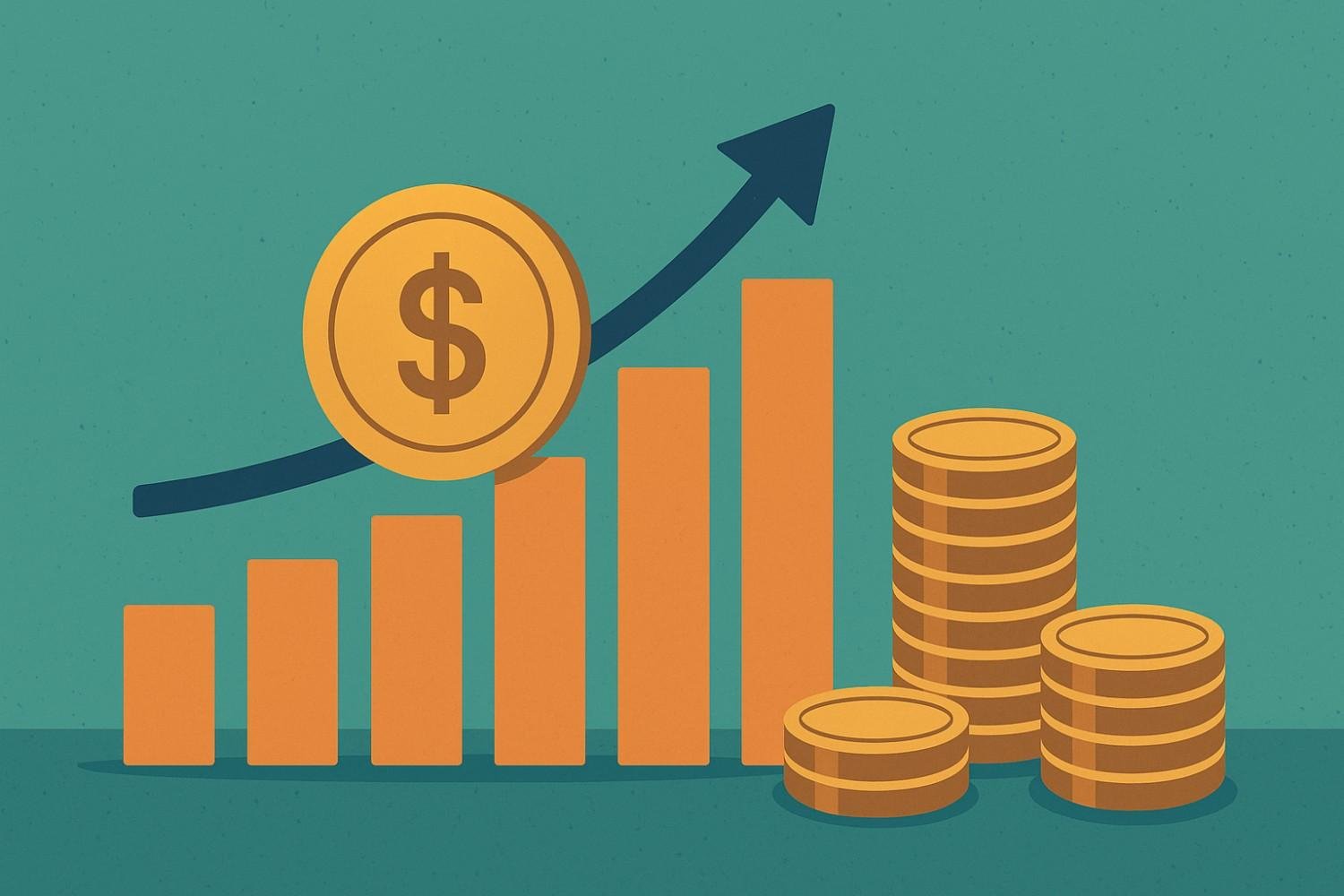
With simple interest, only your starting balance earns interest. With compound interest, last year’s interest gets added to the pile and starts earning interest too. That’s why your balance doesn’t just grow in a straight line—over time, it curves upward and speeds up.
Banks and lenders use compound interest all over the place: savings accounts, money market accounts, CDs, certain bonds, mortgages, credit cards, and personal loans.
How Does Compound Interest Work Step by Step?

Here’s the basic flow of how compound interest works:
- You start with a principal (say $1,000 in a savings account).
- The bank pays you interest at a certain rate (say 5% per year).
- At each compounding period (monthly, daily, annually, etc.), interest is added to your balance.
- Next period, the bank calculates interest on the new, slightly bigger balance.
So if you earn $50 in interest in year one, your year-two interest isn’t based on $1,000 anymore—it’s based on $1,050. That new interest gets added again, and the cycle continues.
The more often your interest compounds (daily vs. monthly vs. annually), the faster your balance grows. That’s why high-yield accounts often advertise both interest rate and APY—APY includes the effect of compounding.
How Do You Calculate Compound Interest?

The standard compound interest formula looks like this:
[ A = P(1 + \frac{r}{n})^{nt} ]
Where:
- A = amount you end up with
- P = principal (starting amount)
- r = annual interest rate (as a decimal, so 5% = 0.05)
- n = number of compounding periods per year (12 for monthly, 365 for daily)
- t = time in years
Example:
- P = $1,000
- r = 5% (0.05)
- n = 1 (compounded annually)
- t = 10 years
After 10 years, your $1,000 becomes about $1,628.89 with annual compounding.
If it compounds monthly, you end up around $1,647.01—a bit more, just because of more frequent compounding.
You don’t have to do this math by hand. Free tools like the SEC’s Investor.gov Compound Interest Calculator let you plug in your numbers and see how your money grows over time.
How Is Compound Interest Different From Simple Interest?
With simple interest, interest is always based only on your original principal. The formula is:
[\text{Simple Interest} = P \times r \times t]
If you invest $1,000 at 5% simple interest for 10 years, you earn:
[1{,}000 \times 0.05 \times 10 = 500 ]
So you end up with $1,500.
With compound interest, you end up with about $1,628.89 (annual) or $1,647.01 (monthly) instead of $1,500, just because interest gets added to the balance and then earns more interest.
Over short periods, the difference can look small. Over decades, it’s massive—especially at higher interest rates.
How Can You Use Compound Interest to Build Wealth?

Here’s where compound interest becomes your new favorite teammate:
- Start early: Time matters more than the amount you start with. Thanks to compounding, money invested in your 20s has a huge advantage over money invested later, even if you invest more later.
- Stay consistent: Regular contributions to a savings or investment account let compound interest work on a growing pile of money.
- Look for higher-yield options (but know the risk): High-yield savings accounts, CDs, and long-term stock market investing can harness compound interest, but risk and returns vary.
- Reinvest earnings: When dividends or interest are reinvested instead of cashed out, compounding speeds up.
A quick mental shortcut is the Rule of 72: divide 72 by your annual rate to estimate how many years it takes to double your money. At 6%, it takes roughly 12 years (72 ÷ 6).
Frequently Asked Questions
1. Is compound interest good or bad?
Compound interest is amazing when you’re the one earning it and painful when you’re the one paying it. In a savings or investment account, it helps your money grow faster without extra effort. On high-interest debt like credit cards, though, compound interest makes balances balloon if you only pay the minimum. So it’s not “good” or “bad” on its own—it depends on which side of the equation you’re on.
2. How often should interest compound to make a difference?
More frequent compounding—like daily versus monthly—does increase your final balance, but the biggest drivers are your rate, time, and how much you contribute. Moving from annual to monthly or daily compounding does help, but not as dramatically as going from 1% to 5% or investing for 10 years instead of 3. So yes, frequency matters, but don’t obsess over it more than your savings rate and time horizon.
3. How much can I really make with compound interest?
That depends on your starting amount, interest rate, compounding frequency, and how long you leave the money alone. For example, $5,000 at 3% compounded daily for 30 years can more than double, while the same starting point invested in stocks with an average 10% annual return could grow to tens of thousands—or more when you add monthly contributions. Online calculators from the SEC, banks, and major finance sites let you plug in your specific scenario.
4. Can compound interest really make me a millionaire?
It can be a huge part of the journey, especially when you combine it with consistent investing and time. Many “ordinary” millionaires reach that milestone by regularly investing in retirement accounts and letting compound growth work for decades—not by winning the lottery. There are no guarantees, and markets involve risk, but compound interest is the engine that makes long-term investing so powerful.
So, Does Future-You Like Free Money or What?
At this point, “how does compound interest work” should feel a lot less mysterious and a lot more like a tool you can actually use. It’s simply the process of earning interest on your principal and on previous interest, creating a snowball effect over time.
My personal rule: let compound interest boost my savings and investments, but never let it quietly inflate my debt. If you start early, stay consistent, and give your money time to grow, future-you will be very grateful you learned this now—and not 10 years from now.